Deconstructing the Fatal Bug of the 'One-Person Company': How to Write the Ultimate Legal Disaster Recovery Code with 1% Family Shares

Deconstructing the Fatal Bug of the “One-Person Company”: How to Write the Ultimate Legal Disaster Recovery Code with a 1% Family Share
1. Introduction
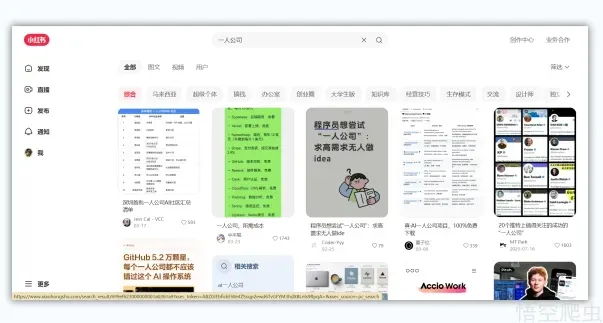
Open X (formerly Twitter) or Xiaohongshu (RED), and you’ll see the myth of the “One-Person Company” has become rampant.
“No employees, no office, rely entirely on AI to write code, and make a million a year all by yourself.” If you have even the slightest yearning for freelancing, this pitch will eventually find its way into your feed. They package this state as the ultimate form of an indie hacker: a “one-person business” in the physical sense, and a “One-Person Limited Liability Company” in the legal sense. It sounds both freeing and secure, allowing you to wear the legendary bulletproof vest of “limited liability.”
As a result, masses of developers and freelancers, full of excitement, rush to the local commerce bureau to register a “One-Person Limited Liability Company” (一人有限责任公司). The moment they get their business license, many think they’ve finally put on the protective talisman of modern commercial civilization, sealing all risks strictly within their registered capital.
But Brother Biao is here to tell you a harsh truth: Operationally, you can be a lone wolf, but in terms of legal structure, going solo is like putting your entire net worth on the roulette table.
That bulletproof vest you think exists won’t even stop a single bullet in court.
2. What Exactly is a “One-Person Company”?
The shortcomings of sole proprietorships (个体户) are well known: unlimited joint liability. You earn hard money, but you carry the risk of bankruptcy. Creditors can easily pierce that paper-thin veil and put your bank cards, cars, and house on the table for liquidation. Precisely because of this, those influencers have room to sell their “solutions.”
Their selling point sounds perfectly logical: Just register a “One-Person Limited Liability Company.” They claim this provides limited liability, meaning no matter how big the risk is, it only burns up to your registered capital. You hold 100% of the equity, you don’t have to split money with anyone, and this is the dignity an indie hacker deserves.
The logic is beautifully flawless. But the problem is, this narrative ignores a legal clause specifically designed for you under Chinese Company Law.
The current “Company Law” stipulates that if the shareholder of a One-Person Limited Liability Company cannot prove that the company’s property is completely independent of their personal property, they must bear unlimited joint liability for all the company’s debts.
Read these words carefully: If you cannot prove it, you are jointly liable.
This is where all the scams blow up. In an ordinary LLC with two or three shareholders, if a creditor wants to pierce the corporate veil to go after your personal assets, they must pull your bank statements and dig up evidence of commingling personal and business funds. This is called “he who asserts must prove,” and the burden of proof is extremely high. Most people simply can’t break through.
But on the battlefield of a One-Person Company, the rules are inverted. The law assumes by default that you and your company are mixed together, and then places the entire burden of proving your innocence squarely on your shoulders. You need to spend your own money and time to produce flawless annual financial reports signed by third-party auditing firms, just to prove to the judge: I have never, in my life, spent a single dime inappropriately from this company’s account.
What is the reality?
In reality, very few solo developers and freelancers can produce such a report, let alone a continuous, complete set of auditing materials covering the entire existence of the company.
Once you can’t produce it, the verdict only has one outcome: that paper-thin limited liability instantly melts down.
Looking back at this deal now: you paid higher registration costs than a sole proprietor, hundreds of bucks a month in accounting fees, and adopted a complex financial process, all in exchange not for safety, but for a paper armor that can’t withstand a single decent attack in court. A sole proprietorship is transparent about its unlimited liability; a One-Person Company first paints you a picture of limited liability, and then waits for you to fall into the trap during the burden-of-proof phase.
In terms of legal risk, it is essentially just a more expensive, more troublesome “pair of crotchless pants.”
3. The Disaster Recovery Architecture: The “99% + 1%” Defense System
Now that the problem is disassembled, here is the solution.
People who truly understand risk management never bet their entire net worth on a line of code without exception handling. They bury an extremely lightweight, redundant node in the system. It stays completely silent normally but activates instantly when disaster strikes. In a legal architecture, this redundant node is called the “1% nominal share.”
The architecture is simple and intuitive:
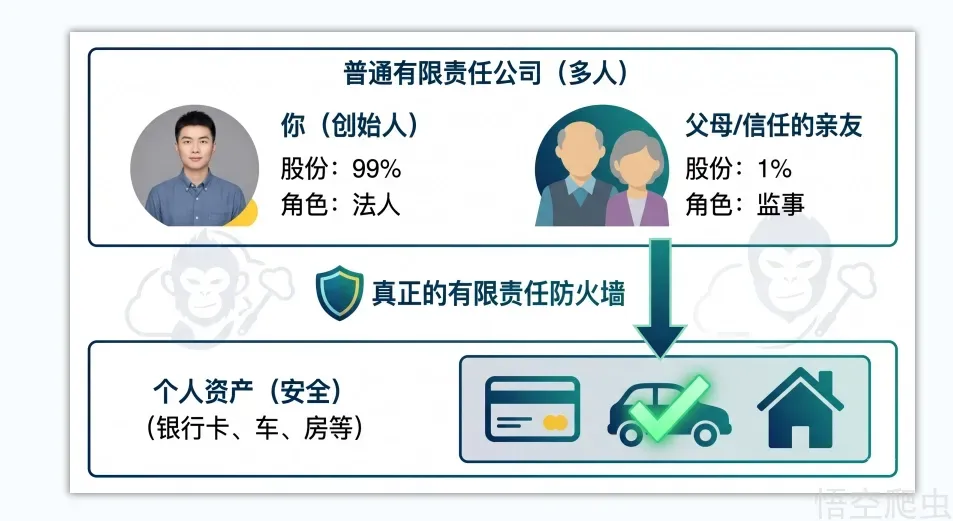
The execution is straightforward. You hold 99% of the shares, and you bring in your parents or a trusted relative/friend to hold the remaining 1%. With just this one step, in the corporate registry and the court’s database, your company’s nature instantly switches from a “One-Person LLC” to a standard “Limited Liability Company” (普通有限责任公司).
This 1% equity shift triggers a fundamental reversal of the legal rules. Remember what we discussed in the last section? If a One-Person Company gets sued, you must pay for audits to prove to the court you never commingled funds—this is a reversal of the burden of proof. But now, the rules of engagement change. If creditors want to pierce the corporate veil and go after your personal assets, sorry, the law reverts to a default track: the burden of proof lies with the plaintiff. The opposing party has to dig up your bank records and find traces of commingling themselves. In judicial practice, this represents a hellish difficulty level, and most plaintiffs simply can’t make it work.
Your limited liability firewall is only truly electrified the moment this 1% equity transfer is completed.
Of course, this 1% nominal defense assumes your actual financial pipelines don’t have “low-level bugs.” If you use your corporate account every day to buy groceries or pay personal rent, even with that 0.1% family share, the court can still shoot right through you using the “Substantive One-Person Company” logic. The 1% is your legal shield, but “strict separation of personal and business finances” remains the underlying operational logic of your daily routines.
By the way, under the new 5-year paid-in capital rules in China, indie hackers should try to keep their registered capital as “lightweight” as possible (e.g., 10,000 or 50,000 RMB). This way, the actual paid-in amount for that 1% is only a few bucks, completely insulating your family member from any potential joint liability risks.
Many people’s first reaction to this is anxiety: If I give my parents shares, do I have to pay them a salary and pay their social security? Do I have to give them a bonus at the end of the year?
The answer is no. This is ownership, not an employment relationship. They are purely shareholders, not employees. The law does not require any company to pay salaries or social security to shareholders; that obligation exists solely in an employment relationship. Their only theoretical source of income is “dividends,” and whether to distribute dividends or not is entirely governed by your single vote as the 99% absolute majority shareholder. If you don’t sign off, that 1% is purely a static configuration item that generates zero financial cost.
To close the loop: have that friend or relative who holds the 1% share also serve as the company’s “Supervisor” (监事 - a statutory role in Chinese corporate governance). The law states a director cannot also serve as a supervisor. So, you serve as the Legal Representative, Executive Director, and General Manager, while the other shareholder takes on the role of Supervisor. Just two people perfectly close the loop of the statutory corporate governance structure, without needing to drag a third person into it.
4. The Complete Compliance Action Guide for Indie Hackers
With the architecture explained, here is the deployment manual.
Putting this plan into daily operation is nowhere near as complex as you might think. Just follow these three steps.
1. The Registration Phase: Don’t Choose the Wrong Company Type
You cannot afford to make a mistake on step one. When registering, directly choose a standard “Limited Liability Company.” Do not check the box for “One-Person Limited Liability Company.” Set up the shareholder structure exactly as outlined above: you take 99%, your nominal proxy takes 1%, and they act as the Supervisor. The entire process is identical to registering a regular company; you just need to submit one extra ID copy.
The essence of this step is choosing the right underlying architecture at the time of system deployment. If you choose wrong, no patches will stick later.
2. Daily Operations and Accounting: Spend a Little to Save a Lot
Once the company is up and running, find a local proxy accounting firm. Do not skimp on this small expense. It solves two core problems for you.
First, cost pooling. Your server fees, AI API subscriptions, cloud bills, and hardware purchases (like laptops and phones) should all go through the corporate account. The accounting firm will compliantly process these as company R&D expenses, lowering your taxable profit on the books.
Second, salary design. Pay yourself a low salary, keeping the amount right around the individual income tax threshold, and stack it with special additional deductions (like mortgage, rent, and child education). This way, the money you transfer from the company account to your personal card each month incurs basically zero personal income tax. At the same time, your social security is normally paid by your company with no gaps. The combined cost is far lower than if you were to pay it yourself as a freelancer.
You’ll find that this accounting framework is completely indistinguishable from any regular micro-enterprise. Even if you get audited, it doesn’t matter—your costs are real, your salary is reasonable, and everything holds up to scrutiny.
3. Physical Isolation of Financial Links: Segregated Account Management
This is the biggest headache for many indie developers doing overseas business, but the principle is actually very simple.
If you don’t immediately need to convert the USD you receive through channels like Stripe or Wise into RMB, just leave it in your offshore accounts. You can put it into low-risk USD money market funds (which currently yield around 5% risk-free annually) and use it directly to pay for your offshore servers and various SaaS subscriptions. The entire financial pipeline runs offshore, meaning it doesn’t trigger any currency exchange processes and stays completely off the domestic tax system’s radar.
Alternatively, handle your procurement and subscriptions for R&D tools directly offshore. This not only physically isolates your business operations but also legally avoids the compliance friction and double taxation costs of frequent currency exchanges. When you need to spend money domestically, you can repatriate it through compliant B2B channels, keeping your books crystal clear and unassailable.
Physically isolate the two pipelines; keep domestic and offshore separate. You no longer have to stress over whether and how to report taxes for every single payment received; the structure itself has already drawn the boundaries for you.
5. Conclusion
In the world of coding, no qualified system architect would bet their life and fortune on a piece of logic with zero exception handling. We write try...except, we deploy redundancies, and we bury monitoring nodes on critical paths. Because we know better than anyone: if the system doesn’t crash, it’s not because you’re lucky, but because you caught every possible exception.
The commercial world operates on the exact same logic.
Those influencers online teaching you to register a One-Person Company are essentially urging you to deploy a production system with zero disaster recovery mechanisms. It might look like it’s running smoothly, but the moment you face a moderately sized lawsuit, the entire system will crash through its illusion of limited liability, taking your personal assets down with it.
This 1% equity design is the most crucial line of exception-handling code you will ever write for your life’s system. It stays completely silent normally, requires no maintenance, and consumes no resources. But when disaster truly strikes, it will be the first to activate, firmly erecting the firewall of burden-of-proof between you and your creditors.
Physically, you can absolutely be a highly efficient, free, and maverick one-person enterprise. But in terms of legal architecture, never register a naked “One-Person Company” that throws you onto the gambling table.
True freedom is never the bravery of streaking naked. True freedom is dancing in the air with a safety net below.

Thank you for reading, friends! If you found this content interesting, please don’t hesitate to like, share, and subscribe!
If you want to be the first to catch our articles in the future, don’t forget to star ⭐ our account so you don’t lose track of us.
That’s all for today.
Through triumph and defeat, life is a grand adventure. See you next time!
Official Account and Community
Welcome to join our community for discussions.